Cereal box inserts
Cereal box inserts are the paperboard or corrugated fitments that go inside a carton to hold its contents in place: dividers between mini packs, cradles for pouches and jars, platforms that lift a product to a window. They are what turn a box of loose items into a set that arrives arranged. We design each insert with the box it sits in, cut from the same kinds of board, so the two fit by construction.
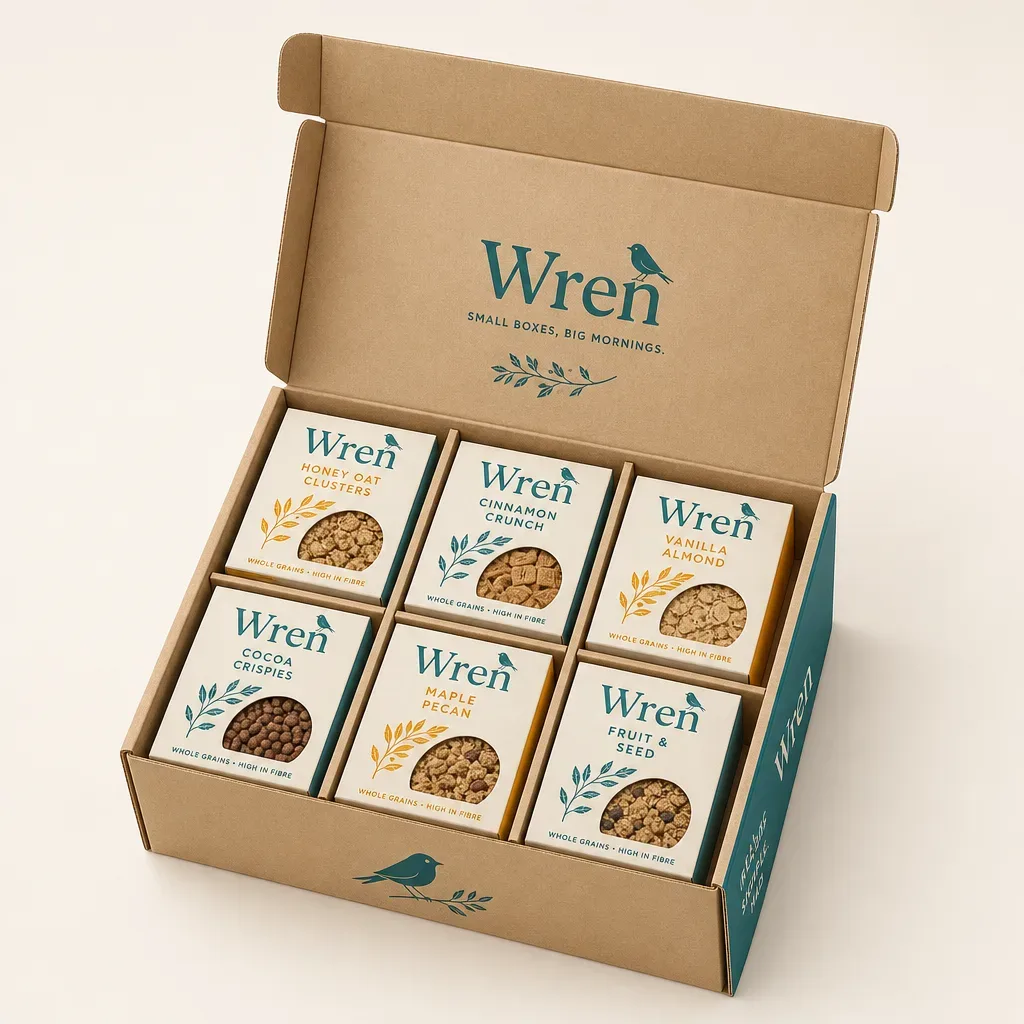
Cereal carton dividers that keep a set looking like a set.
Put six small packs in a box with nothing between them and they will have rearranged themselves by the time the box is opened. Corners get knocked, pouches slump, a jar ends up on its side. An insert gives every item its own space. The box opens to the layout you designed, and nothing has been rubbing against anything else on the way.
It also does structural work. Partition walls brace the outer box against crushing and stop heavy items loading light ones. For variety pack cereal boxes and gift sets, the insert is not an extra; it is the part that makes the pack function.
 interlocking slot — macro detail
Six elements of well-made partition inserts.
Select a marker or step through the list.
Strips that run the length of the box, slotted from the top edge. They set the number of rows.
Flat strips, slotted to mesh.
The commonest insert is a set of flat strips with slots cut halfway through. Slotted from opposite edges, they slide into each other and stand as a grid. Other types are folded from a single sheet. All ship flat. Inserts are drawn on the same principles as cartons; see how cereal box dielines work.
Board and finish for a box insert for variety packs
Select an option to update the specification. Inserts are usually plain; the choice is about stiffness and appearance. See board grades for cereal packaging.
Insert specification
Where an insert makes the pack work
From contents to fitted insert
About cereal box inserts
What a cereal box insert is
A cereal box insert is any separate piece of board placed inside a carton to position, separate or support what it contains. It is not part of the box's own structure and is usually cut from a different sheet. Inserts are also called fitments, dividers, partitions or, when they raise the product, platforms.
In cereal packaging they appear wherever a box holds more than one thing: several mini packs, a group of pouches, a product with an accessory. They are designed alongside the outer and offered across our made-to-measure cereal cartons.
Best uses
Inserts are used in variety packs, tasting sets, cereal gift sets, breakfast hampers and cereal subscription boxes. They are also used for promotional packs that include a bowl, a spoon or a toy, where the extra item needs its own compartment away from the food.
A single bagged cereal in a standard carton needs no insert; the bag fills the box. Nor does a tightly packed multipack, where the packs brace each other. Inserts earn their cost when contents are mixed, fragile, or meant to be presented. At the top of that range, the insert sits inside a rigid set-up cereal box.
Structure and closures
Three families cover most needs. Cross partitions are interlocking slotted strips forming a grid of cells; they suit rows of similar items. Folded fitments are cut and scored from one sheet and fold into cradles, sleeves or stepped shapes; they suit mixed items of different sizes. Platforms and pads are flat or folded floors that lift, level or cushion.
Cell size is the item's size plus a small clearance on each side. Partition height is normally a little less than the item's, so items can be gripped. Fitments with shaped cut-outs are drawn around the item's footprint. The outer is often a two-piece cereal box, a sleeve and tray pack or a mailer.
Material options
Paperboard inserts, in 16 to 24pt, are thin, tidy and adequate for light items such as mini cartons and pouches. Kraft is a popular choice because it looks finished without printing. Where items are heavy or fragile, such as glass jars, E-flute corrugated adds cushioning and stiffness.
Paper-based inserts keep the whole pack in one material stream, which matters if you make recycling claims. Foam and plastic trays hold shape well but add a second material; we would usually look for a folded-board answer first. See recycled cereal boxes for board with post-consumer content.
Printing and finishing
Most inserts are unprinted. They are seen only when the box is open, and plain kraft or white board reads as clean and deliberate. When print is used, it is usually a single colour: a tint to match the brand, a message under each item, or flavour names on a platform.
Printing the insert is one of the more effective ways to add something to the opening experience, since it is revealed as items are lifted out. It pairs naturally with a printed interior on the outer; see inside printed cereal boxes. Finishes are rarely needed, though soft-touch on a visible platform can be worthwhile.
Size considerations
The insert, the contents and the box are sized as one problem. Start with the items and their arrangement. Add clearances and the thickness of each partition wall. The total is the inside of the box. Working the other way, from a box size you already like, often leaves cells that are slightly wrong.
Board thickness adds up. A grid with three long strips and two cross strips adds several board thicknesses to each dimension, which matters on a tight fit. Sizes of common mini and portion packs are given in the cereal box dimensions guide.
Retail considerations
In store, an insert keeps a set presentable after it has been handled: picked up, tilted, put down again. For packs with a window, a platform stops the contents sinking out of sight. For sets sold online, the insert is what prevents the damage and bad reviews that come from loose contents.
If the pack will be posted, the insert should hold items away from the walls, not against them, since the walls take the impacts. Requirements for shipped packs are covered in cereal packaging for eCommerce.
Artwork tips
If the insert is printed, we supply its own dieline. Keep designs simple and tolerant: partitions are small pieces and a millimetre of movement is visible on fine detail. Place any text where it will be uncovered as items are removed, not hidden behind a wall.
Mark on your layout which way up each item sits and which face shows, so cells are sized to the right dimension. Send samples of unusual items. For the outer's artwork, see the artwork preparation guide. Then request an insert and box quote.
Send the contents list. We will draw the insert.
List what goes in each box, with sizes, and we will return a layout drawing showing the insert type, the cell arrangement and the box dimensions it leads to.
Cereal box inserts: frequently asked
Separate pieces of paperboard or corrugated board placed inside a carton to hold, divide or raise its contents, such as partitions between mini packs or cradles for pouches.
More than one thing in the box? Start with the layout.
A contents list and a quantity are enough. We will draw the insert and the box as a pair and price them together.