Custom window cereal boxes
Custom window cereal boxes have a die-cut viewing panel with clear film patched behind it, cut into a printed or kraft carton so the product itself does part of the selling. Each carton is drawn to your dimensions, with the window placed clear of scores and above the fill line.
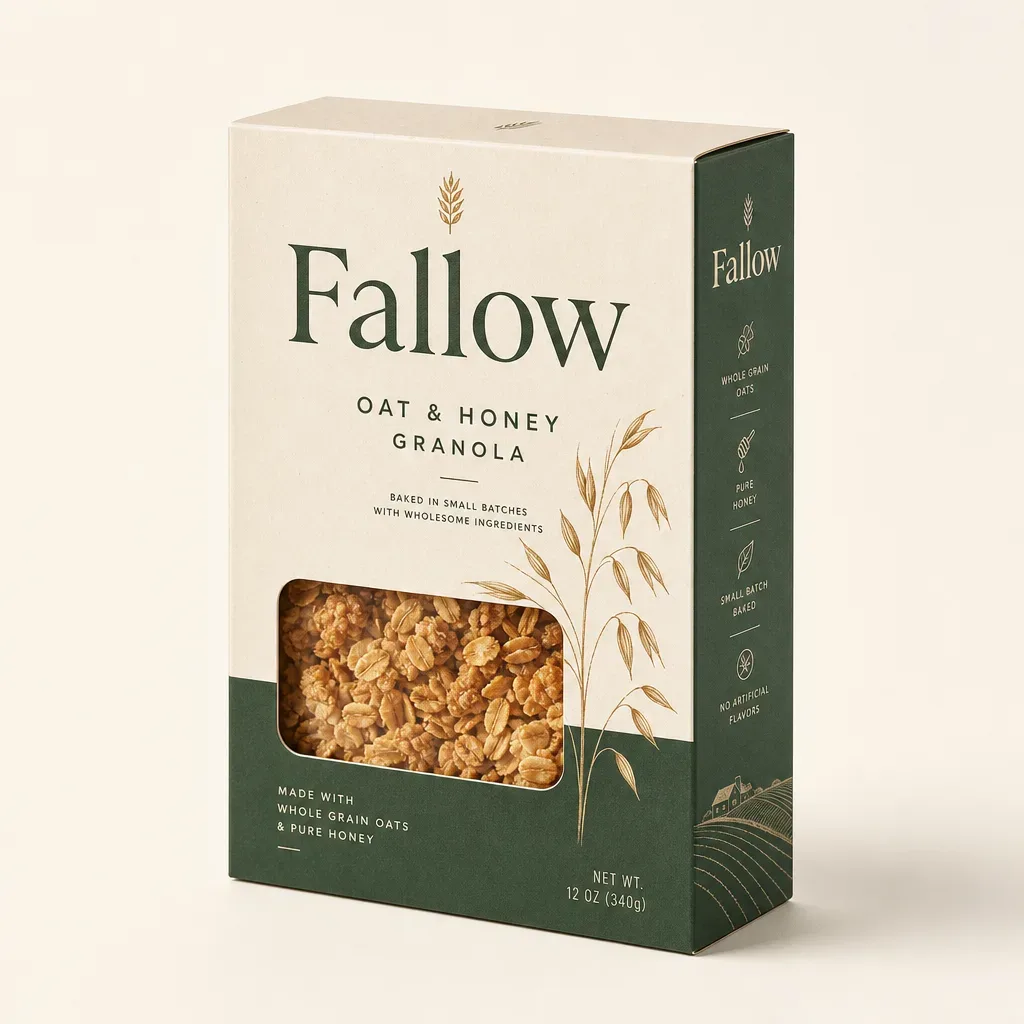
Show more of what you're selling.
Granola clusters, fruit pieces and oat texture are the differentiator in the aisle, and no printed photograph carries them as convincingly as the product itself. A window turns the front panel into evidence, which is why it earns its extra patching step on premium and natural lines such as granola packaging.
The trade-off is structural. Every window removes board from a panel that has to stay flat through facing, so placement is drawn around the scores and the fill line rather than dropped in at artwork stage.
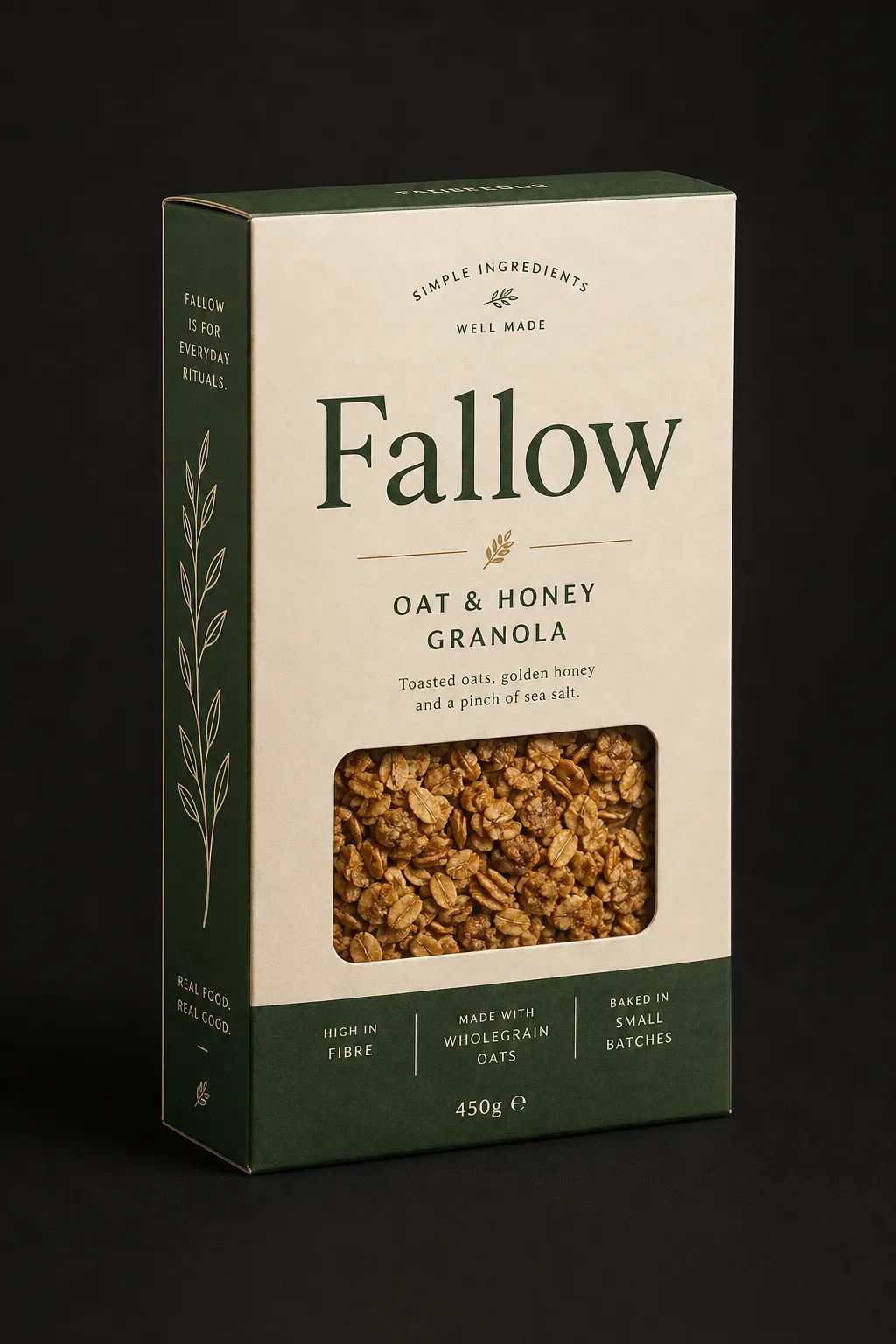
Six parts that decide the carton.
Select a point on the carton — or step through the list.
Brand, variant and claim hierarchy. The window sits inside this panel, so the layout is built around the aperture rather than over it.
Flat, folded, finished.
The window is die-cut in the flat and patched before folding, so the film sits inside the panel and the printed face stays uninterrupted. The aperture sits in the panel of a straight tuck end carton or any other structure we make.
Board, print and finish for a windowed carton
Selecting an option updates the spec matrix below. Boards are compared in kraft vs SBS for cereal cartons.
Specification
Where a window earns its place

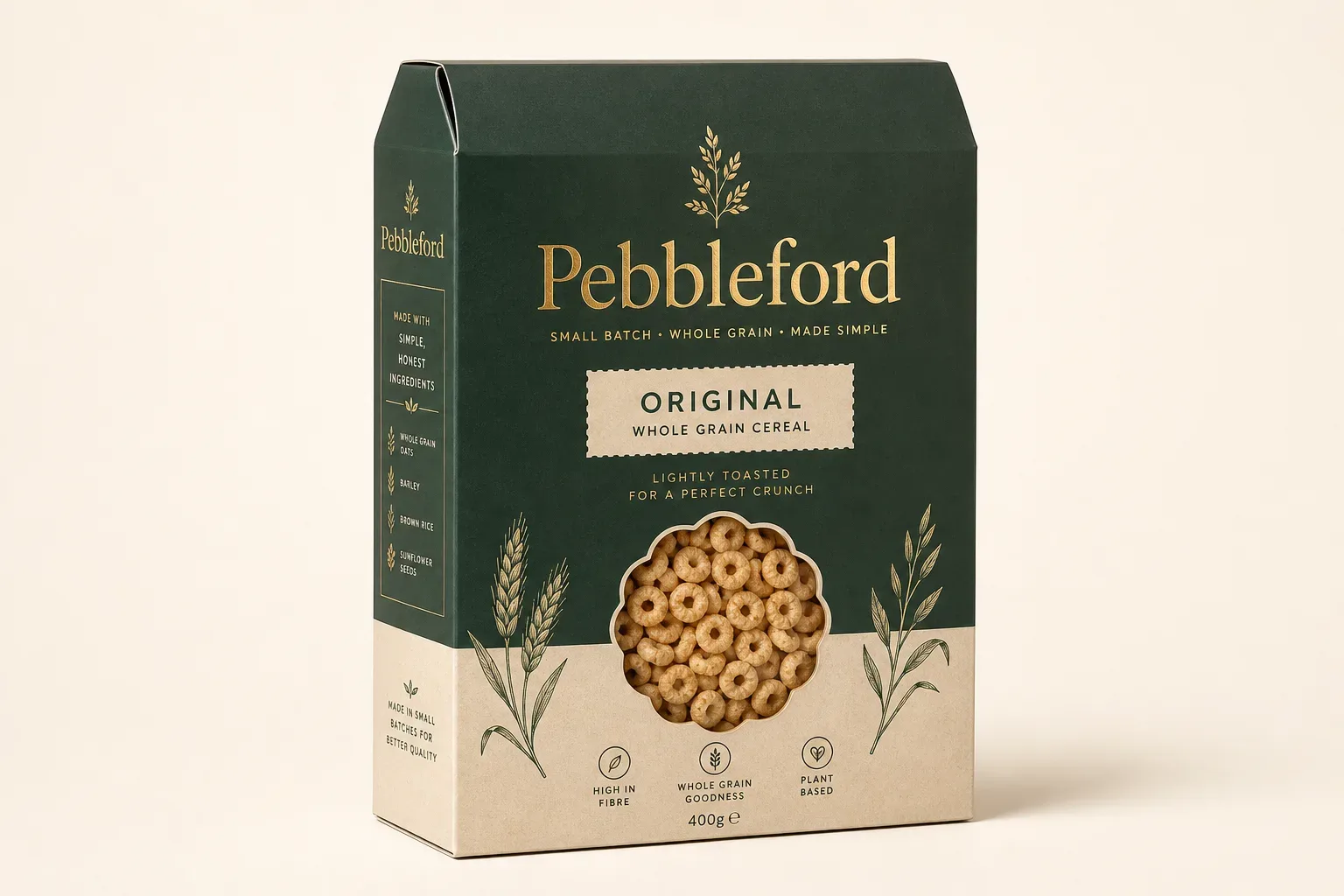

From spec to delivery
About custom window cereal boxes
What a window cereal box is
A window cereal box is a folding paperboard carton with a die-cut aperture in one panel, backed by clear film patched to the inside face. Structurally it remains a standard cereal carton — tuck or auto-lock closures, printed and laminated board, flat-packed for filling — with two extra production steps: the aperture is cut alongside the outline, and film is applied on a patching line before folding and gluing.
Because the film sits behind the board, the printed face stays continuous and the aperture edge stays clean. That is what separates a manufactured window carton from a cut-out added after the fact. Shaped apertures are covered on our die-cut cereal cartons page.
Best uses
Windows work hardest where the product itself is the claim: granola clusters, muesli with visible fruit and seed, nut-and-oat blends, and premium or organic lines whose positioning rests on ingredient quality; see muesli packaging.
They add less on fine flakes, puffed grains and children's shapes, where printed character usually outperforms a view of the product.
Structure and closures
Straight tuck cartons keep the front panel uninterrupted and are the usual choice when a window sits high on the face. Reverse tuck reduces tooling cost with no change to the shelf face. Auto-lock and crash-lock bottoms are specified for heavier fills such as clusters and nut blends, where a tucked base would bow under weight.
Whichever closure is used, the aperture is kept clear of every score so the panel folds square.
Material options
18pt SBS is the default: a coated white face for high-fidelity print and a clean white cut edge at the aperture. 18pt kraft suits natural positioning, with visible fibre at the cut; see kraft cereal boxes. Recycled board carries the strongest material story but shows a grey core at the edge.
Where the aperture is large, we step up a caliper to keep the panel rigid.
Printing and finishing
Longer runs print offset, which holds Pantone brand colour consistently across reruns; short runs and per-flavour versioning print digitally. Matte lamination with spot UV on the claim block is the common retail pairing — low glare across the panel, selective gloss where the eye should land.
Foil and emboss are used on premium tiers, kept away from the aperture edge so the patching bond stays clean; see spot UV cereal boxes.
Size considerations
Cereal is sold by weight and packed by volume, so the carton is sized around bulk density plus headspace for settling. Give us a fill weight and we return dimensions; see the cereal box dimensions guide.
Windows scale with the panel: on mini and single-serve cartons the aperture stays small to preserve stiffness; on family-size cartons a larger window is possible but usually pairs with a heavier board.
Retail considerations
On a facing shelf the window has to read as part of a block, not as a hole. Keep the aperture in the same position across a range so the set looks deliberate, and hold the variant cue in a fixed zone.
Panels must also stay flat after repeated facing — a reason placement is drawn against the scores rather than chosen visually.
Artwork tips
Supply artwork on the dieline we issue, with 3mm bleed and 4mm safety from every fold. Keep the barcode on a flat panel with its quiet zone intact, and keep type and regulatory content clear of the aperture edge.
If the window shape is custom, design to the cut path we supply rather than an approximation. File set-up is covered in the artwork preparation guide; when you are ready, ask for window carton pricing.
Hold a patched window carton before you commit.
We will send a plain folded carton with a patched film window, so you can check the aperture edge, the film clarity and how the panel stands up when faced.
Window cereal boxes, answered
Almost any — the constraint is panel area, not overall size. On mini and single-serve cartons the aperture has to stay small enough that the panel keeps its stiffness.
Send us the product. We'll draw the window around it.
Dimensions or fill weight, quantity and artwork status is enough for pricing and a dieline recommendation.
