Gable cereal boxes
Gable cereal boxes are cartons with a peaked top that closes into a built-in handle, so the pack can be picked up and carried in one hand. They ship flat, pop up on a locking base and close without glue. That makes them a natural fit for cereal gift packaging, events and anything handed across a counter, more than for a standard supermarket facing.
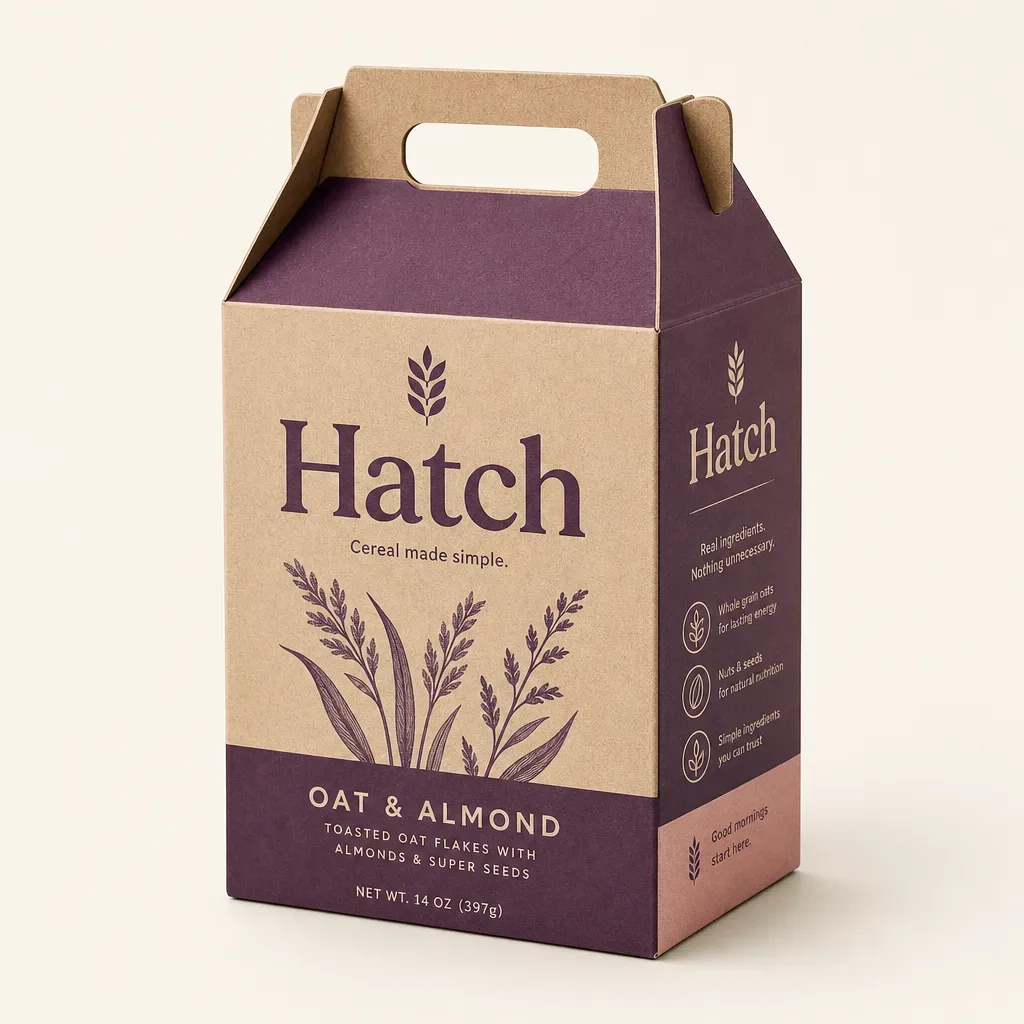
Cereal boxes with a handle, made to be carried.
Most cereal cartons are designed to stand on a shelf. A gable box is designed to leave with someone. The roof panels fold up and lock into a handle, so a customer can carry it out of a shop, a guest can take it home from an event, and a child can carry their own. The format reads as a gift before anyone looks at the print.
That same top is its limitation in a grocery aisle. The peak adds height that holds no product, and nothing can be stacked on a handle. For everyday retail a sealed cereal carton is the efficient choice; a gable earns its place where presentation and carrying matter more than cube.
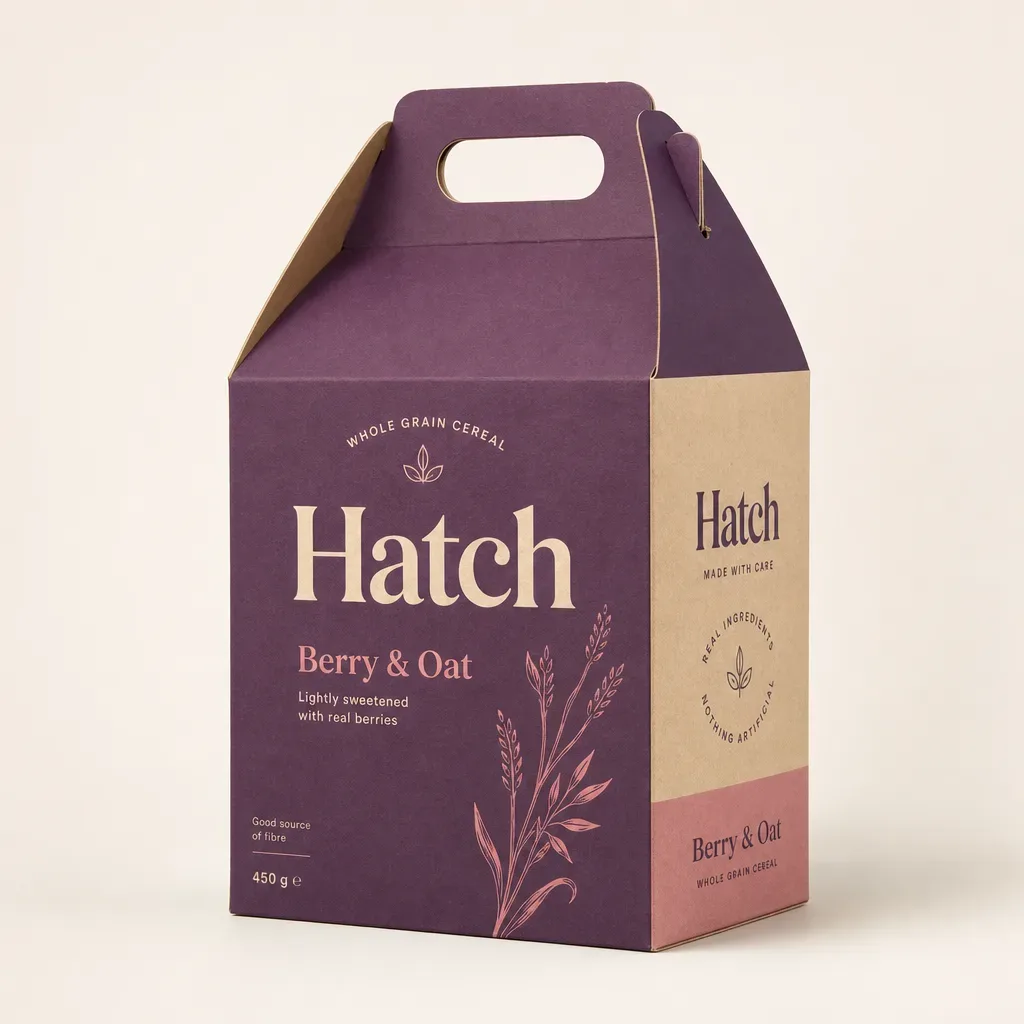 interlocked handle — macro detail

Six parts of a gable top carton.
Pick a marker on the carton or read down the list.
Formed from the top edges of both roof panels. One passes through or locks against the other, so the load is carried by two thicknesses of board.
Flat, popped up, handle locked.
A gable carton arrives flat with its seam, and usually its base, already glued. Opening it forms the body; folding the gussets in and bringing the roof panels together forms the handle. The base options are the same as on auto-lock bottom cereal boxes.
Board, print and finish for a gable top cereal box
Select an option to update the specification. The handle sets the minimum board strength; grades are compared under cereal carton materials.
Gable carton specification
Where a carry handle makes sense


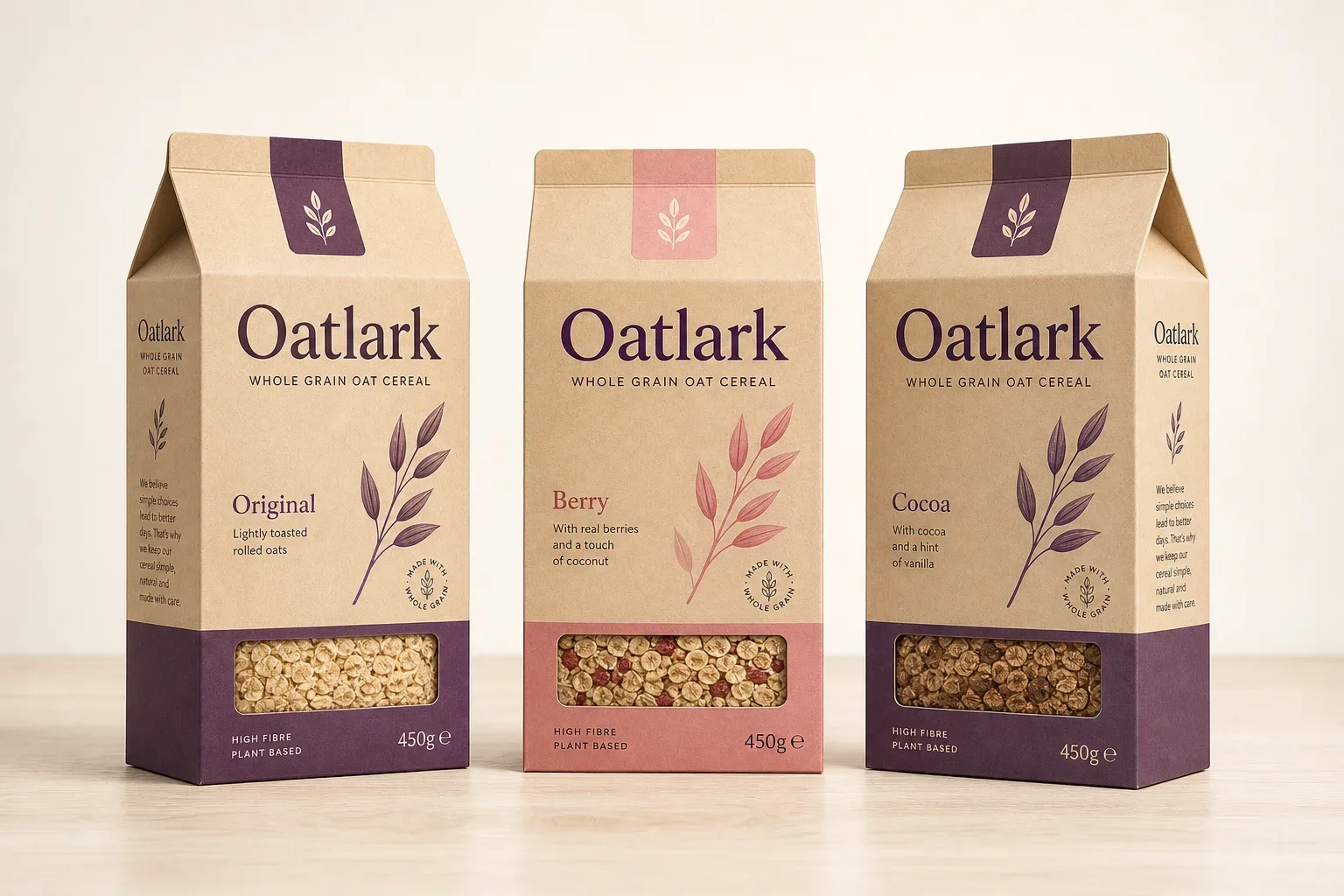
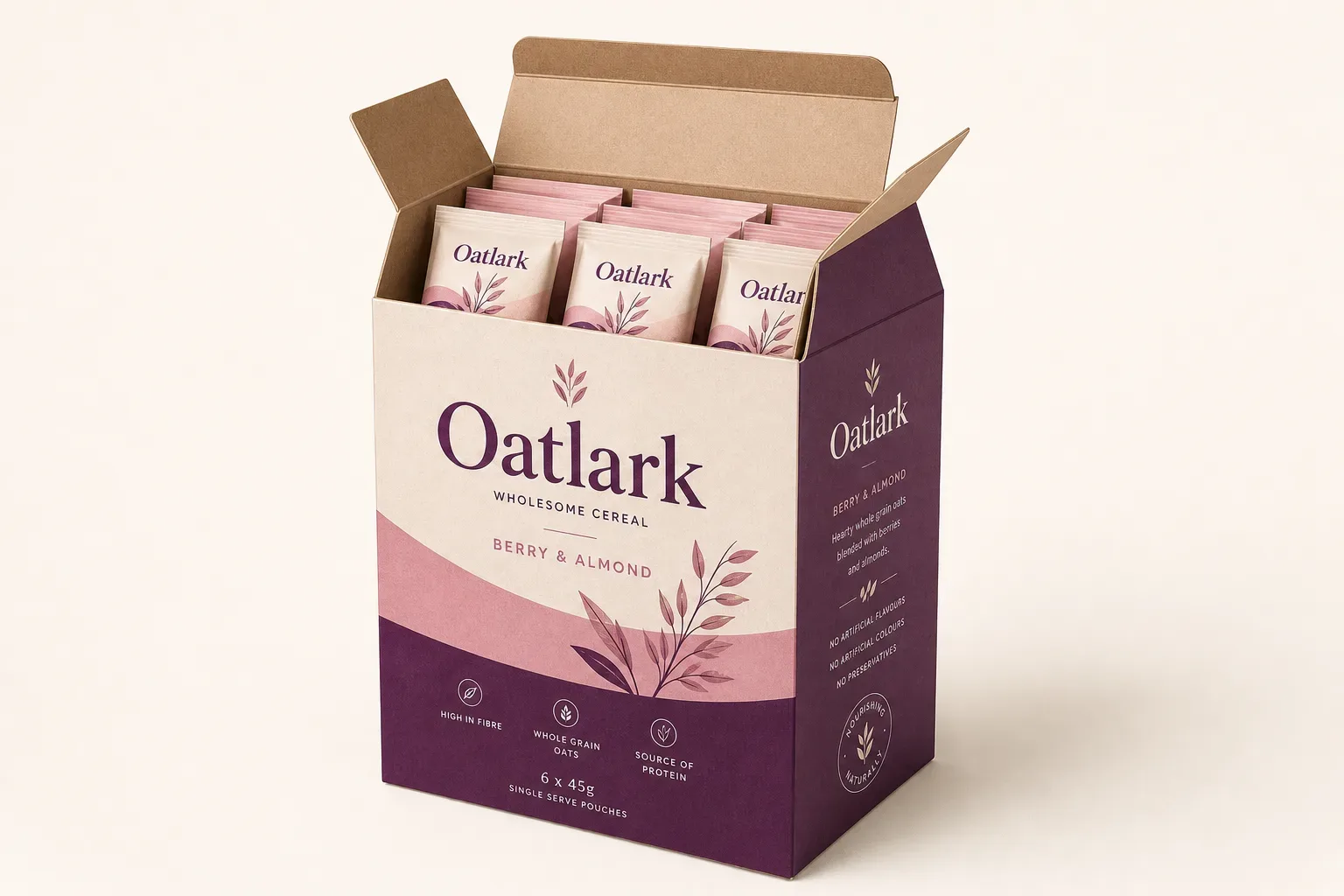
Six steps to a finished gable
About gable cereal boxes
What a gable cereal box is
A gable cereal box is a folding carton with a rectangular body and a top that closes into a peak, like the gable end of a roof. Two roof panels, hinged from the front and back, meet at a ridge; the side panels fold inward along diagonal scores to close the ends. The top edges of the roof panels are shaped into a handle that locks the two together.
The format is familiar from takeaway and party packaging. Applied to cereal, it holds a bagged or pouched product in a pack that can be carried. It is one of the specialty structures in our custom cereal boxes and cartons.
Best uses
Gable boxes do well wherever cereal is given, sold face to face or taken away: gifts, seasonal packs, party favours, breakfast kits, and corporate and event cereal packaging. They are popular for granola from bakeries and cafes, where the pack leaves in the customer's hand.
They also work as an outer for several smaller items, such as a variety pack of cereal boxes or a set of pouches, kept apart by partition inserts. Where a flat presentation suits better, a lid and base cereal box is the alternative. They are less suited to dense supermarket shelving, to stacking, or to automated filling lines.
Structure and closures
Three things have to be right. The base must be a locking one, because the pack is lifted from the top and the base carries everything. The handle should use both roof panels, so the load passes through two layers of board. And the hand slot needs rounded ends; a square-cornered slot will tear from the corner under load.
The gable closes without glue and can be reopened, which suits gifting but means it is not tamper-evident. A seal label over the handle solves that. The top is not a barrier either, so loose cereal goes in a sealed bag; see cereal boxes with an inner bag.
Material options
Kraft is the usual recommendation. Its long, unbleached fibres resist tearing at the handle better than most coated boards of the same caliper, and its look suits the format. SBS gives a white surface for full-colour work and is fine on lighter contents. For large gables or heavy kits, E-flute corrugated takes over.
Whatever the board, we set the grain to run up the carton and through the handle, so the fibres are loaded along their length. A handle cut across the grain is noticeably weaker. If natural board is central to your brand, see kraft cereal boxes.
Printing and finishing
A gable has more visible surfaces than a standard carton: front, back, two sides and two roof panels, all seen as the pack is carried. Artwork should treat the roof as part of the design. One- and two-colour print on kraft is economical and looks right; full-colour offset or digital print on SBS suits brighter ranges.
Lamination adds tear resistance at the handle and is worth considering on coated board. Heavy coatings are kept out of the base glue areas. Foil or spot UV on the roof panels catches the light as the pack moves. Finish options are shown under coatings for cereal cartons.
Size considerations
Size the body to the contents: bag or pouch dimensions plus a little clearance. Gable proportions are squarer than a normal cereal carton, since depth has to be large enough for the gussets to fold. The gable height follows from the depth: roughly, the deeper the carton, the taller the peak.
Remember that the peak holds no product. A gable sized for a standard fill weight will stand taller than the equivalent flat-topped carton. For small portions, a gable version of a mini cereal box is a common party and sampling format.
Retail considerations
In store, gable boxes belong where they can be seen whole: counter tops, gift tables, end displays and hampers. On a standard shelf they waste height and cannot be stacked two high. They also take more room in a shipping case when packed erected, so most producers receive them flat and fill them near the point of sale.
Because the top reopens, add a seal label wherever food-safety expectations are formal. Barcode and legal copy go on the back or a side panel, never on the roof, where they would be read at an angle.
Artwork tips
Use our dieline; the roof panels and gussets are easy to get upside down on a generic template. Keep 3mm bleed and 4mm safety from scores, and keep logos clear of the handle slot. Remember that the two roof panels face opposite ways, so each should read correctly from its own side.
Leave the gussets plain or in a flat colour, since they fold out of sight. If you want a window, the front panel is the stiffest place for it. A filled sample is the best test of handle strength; cereal box samples and prototyping explains what we send. Then request gable carton pricing.
Carry-test a plain gable sample before you print.
We will cut a plain gable in your size and proposed board so you can fill it with your own product and lift it by the handle. It is the quickest way to confirm base, handle and board before artwork.
Gable cereal boxes, answered
Cartons with a peaked top that closes into a built-in carry handle. They ship flat, pop up on a locking base and close without glue.
Something to carry out of the door? Tell us what goes inside.
Contents, total weight and quantity are enough. We will size the body, the handle and the base, and send a sample to carry.
