Personalized cereal boxes
Personalized cereal boxes are cartons where part of the design changes from box to box: a name, a photo, a message, a number or a whole face. They are printed digitally, so every carton in a run can be different without plates. Companies order them for gifting, events, influencer mailings and limited campaigns; individuals order them as one-off presents. This page explains how variable printing works, what data and artwork it needs, and where it stops being economical.
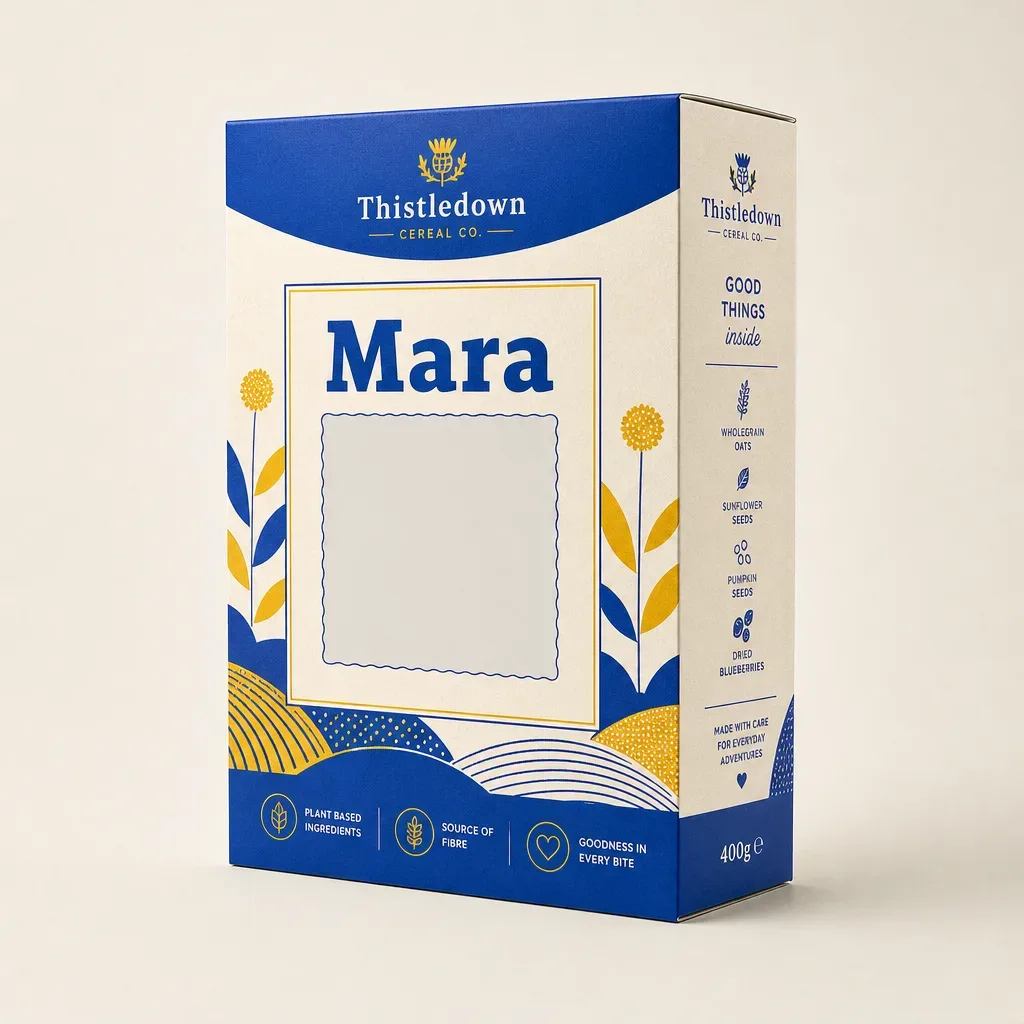
Custom name cereal boxes turn a pack into a present.
A cereal box is one of the most familiar objects in a kitchen, which is why putting a person's own name or face on one works so well. It is recognisable, a little absurd and usually kept. For a brand, a box made for one named person gets opened, photographed and talked about in a way a standard sample does not.
Digital printing made this practical. With no plates to make, a run of two hundred cartons can carry two hundred different names at close to the cost of two hundred identical ones. The same method is used for short test runs; see cereal box mockups and prototypes.
 digital print — macro
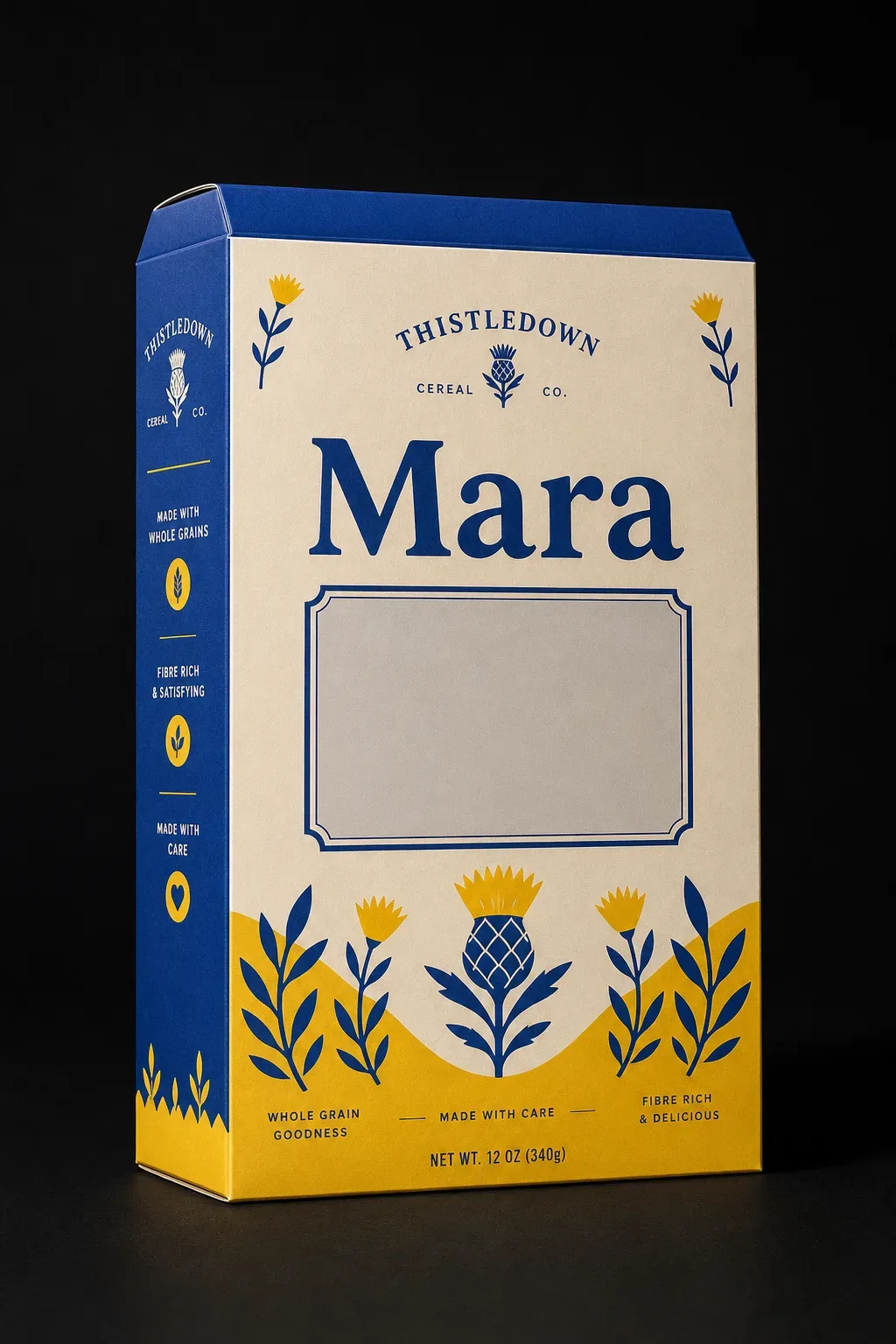
Six parts of a photo cereal box design that can change.
Select a point on the carton, or read the list.
The part that is the same on every box: brand, layout, legal text. It is designed once.
A standard carton, printed one sheet at a time.
Personalization changes the print, not the structure. Short runs are usually hand-packed, so easy-closing styles are preferred, most often straight tuck end cereal boxes that need no glue at the bench.
Board, print and finish options for variable cartons
Select an option to update the specification. Boards and print methods are described on the materials and printing page.
Personalized carton specification
Who orders personalized cartons
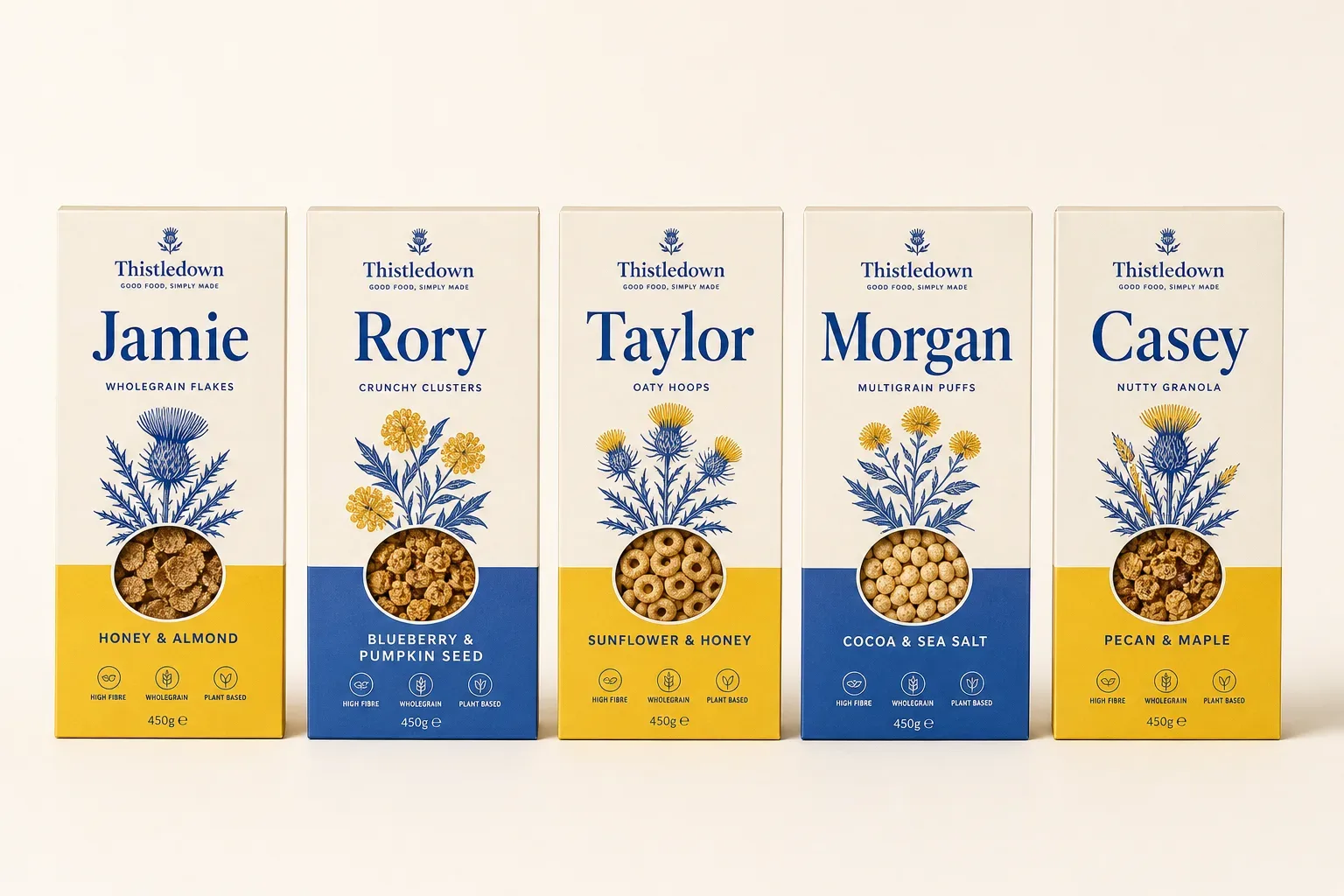
How a personalized run is produced
About personalized cereal boxes
What a personalized cereal box is
A personalized cereal box is a carton on which some content is specific to a person or a small group. The carton is built from a template with fixed areas and variable fields. Software merges the template with a list of names, messages or image files to produce a separate print file for each carton, and a digital press prints them in sequence.
This is different from a custom box, which is designed for a brand and printed identically in volume. Custom is the subject of our custom-designed cereal carton range. Personalized means the boxes within one order differ from each other.
Best uses
Business uses are the larger part: gifts to clients and staff, packs sent to journalists and creators at launch, event favours, loyalty rewards, and campaigns with regional or numbered versions. See corporate and event cereal packaging. The appeal is attention. A box with the recipient's name on it is opened and shared.
One-off orders from individuals, such as a birthday or wedding box with a photo, use the same process. Personalization is not suited to ordinary retail stock, where every pack must be identical, scannable and produced at the lowest unit cost.
Structure and closures
Any structure can be personalized. In practice, short runs are packed by hand, so tuck-end cartons that close without glue are the norm. Where the pack is a gift, a presentation format lifts it further; see cereal gift boxes.
The cutting die is the one fixed cost that digital printing does not remove. If your size matches an existing die, tooling is avoided. For very small quantities, cartons can be cut on a digital cutting table with no die at all, at a higher cost per piece.
Material options
Coated white board gives the best digital result, especially for photographs, where skin tones need a neutral base. Coated recycled board is fine for names and graphics. Not every board runs on every digital press, so the stock is confirmed with the press in mind.
Kraft can be personalized with dark text and line art. Photos on kraft lose their highlights, because there is no white in digital CMYK unless a white ink is added first. See kraft cereal boxes for how print behaves on brown board.
Digital and hybrid printing
Digital presses print directly from files with no plates, so changing the image between sheets costs nothing. Quality is close to offset for most work. Solid brand colours are simulated from process inks and may differ slightly from an offset-printed pack; where exact colour matters, see Pantone printed cereal boxes.
For larger campaigns there is a hybrid route. The fixed design is printed by offset in volume, and the variable part, usually a name or code, is added afterwards by digital or inkjet overprinting. Lamination, spot UV and foil can all be applied to digital print. Digital foil and digital spot UV can themselves be varied from box to box.
Size considerations
Digital press sheets are generally smaller than offset sheets. Standard cartons fit comfortably. Very large family-size or club cartons may not fit a given digital press and need checking. Mini cartons are efficient, since many fit on one sheet; see mini cereal boxes.
Quantity sets the method. For tens to a few thousand cartons, digital is usually the economical choice. Beyond that, the cost per carton of offset falls below digital, and the hybrid route becomes worth considering.
Compliance, data and rights
If the box contains food that is sold or given to the public, the usual labelling rules apply to every version: ingredients, allergens, net quantity, dates and business details. These stay in the fixed part of the template and are checked once.
Names and photos are personal data. Lists should be shared securely, used only for the job and deleted afterwards; tell us your requirements. The customer is responsible for having the right to use every image and name supplied. We do not reproduce other companies' trademarks, characters or pack designs on personalized cartons.
Artwork and data tips
Design the template around the extremes. Test the name field with the shortest and the longest name on the list, and decide whether long names shrink, wrap or abbreviate. Choose a font that has every accented character your list contains.
Supply data as a spreadsheet with one row per carton and one column per field, and images named to match. Photos should be at least 300 dpi at printed size. Ask for merged proofs of the awkward cases, not just the first row. See the artwork preparation guide, then request a personalized carton quote.
Get the data sheet and template guide.
We will send a spreadsheet layout for names, messages and image files, with a short guide to setting up variable fields, so your list arrives ready to merge.
Personalized cereal boxes: common questions
Yes. With digital variable-data printing, each carton is printed from its own file, merged from your list.
Have a list of names? We'll turn it into a run of boxes.
Send your size, quantity and what should change on each carton. We will build the template, check the data and proof merged samples.